

What is Dyslexia?
Dyslexia is a specific learning disorder in reading. People with dyslexia have a hard time picking up the skill of fluent and accurate reading, and may have trouble with reading comprehension, spelling and writing.
This is how The International Dyslexia Association defines dyslexia:
“Dyslexia is a specific learning disability that is neurobiological in origin. It is characterized by difficulties with accurate and/or fluent word recognition and by poor spelling and decoding abilities. These difficulties typically result from a deficit in the phonological component of language that is often unexpected in relation to other cognitive abilities and the provision of effective classroom instruction. Secondary consequences may include problems in reading comprehension and reduced reading experience that can impede growth of vocabulary and background knowledge.”
(Adopted by the IDA Board of Directors, Nov. 12, 2002. Many state education codes, including New Jersey, Ohio and Utah, have adopted this definition.)
“Reading is a very important life skill, but it is not a measure of intelligence”
~ Ingrid Poupart
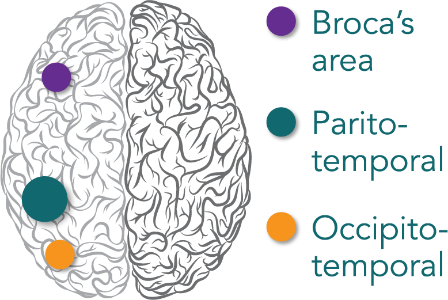
Typical Brain:
Dyslexic Brain:
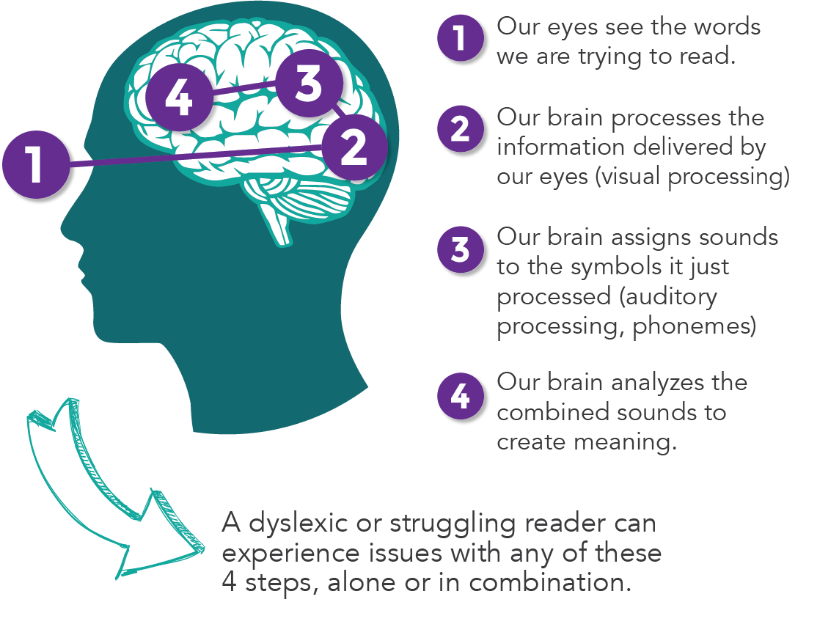
Typical Brain: Typical readers use the left side of their brain, which is generally associated with language, to process reading. Visual processing, auditory processing (phonemes) and decoding all happen in a matter of milliseconds thanks to a highly efficient neural network.
Dyslexic Brain: Dyslexic readers rely more heavily on the right side of their brain, which is generally associated with spatial activities. The information travels farther and in a less organized manner, which can lead to information loss, mix-up and slower processing.
Dyslexia Facts
- Dyslexia affects 20 percent of the population and represents 80–90 percent of all those with learning disabilities. It is the most common of all neuro-cognitive disorders.1
- Dyslexia does not reflect an overall defect in language, but a localized weakness within the phonologic module of the brain (where sounds of language are put together to form words or break words down into sounds).2
- Dyslexics are not more prone to letter reversals than non-dyslexics. Letter reversals are common among many young children who are learning to read and write, and many dyslexic children do not reverse letters.3
- Nearly the same percentage of people from different ethnic and socioeconomic backgrounds have dyslexia.4
- 80% of children with an IEP have reading difficulty and 85% of those are Dyslexic.4
Dyslexia Screening
An official dyslexia diagnosis can only be obtained from a qualified professional. If you’d like to assess your risk of dyslexia you can complete our Dyslexia Quick Screen, or our more comprehensive Dyslexia Screening below.